


There’s a conversation we have regularly with growing businesses. It usually starts with a client request that WordPress can’t quite handle cleanly. Maybe it’s a complex procurement workflow that needs to talk to an ERP. Maybe it’s a high-volume API that needs to process thousands of requests without touching the CMS. Maybe the client has simply scaled to the point where the WordPress paradigm creates more friction than it solves.
For a long time, the default answer to that conversation was, find a plugin, find a workaround, make WordPress do it anyway.
That answer is getting harder to defend.
WordPress Is Still the Right Tool – Until It Isn’t
WordPress remains one of the most powerful and versatile platforms available. After 15 years and over 500 WordPress and WooCommerce builds, we have seen it handle everything from simple corporate brochure sites to complex membership platforms, multi-currency e-commerce operations, and content networks serving millions of monthly readers. WordPress earns its dominance.
But the clients who have been with you for five or ten years do not have the same needs they did when you first built their site. They have grown. Their tech stack has grown. They have acquired systems, CRMs, ERPs, inventory platforms, finance tools, that need to talk to each other in real time. Increasingly, they are asking for things that sit outside the WordPress model entirely: custom internal tools, automated workflows, and API layers that connect their digital presence to the rest of the business.
When a client reaches that inflection point, the worst response is to shoehorn the solution into WordPress because that is what the team knows. The second worst response is to walk away from WordPress entirely and rebuild from scratch. The right answer, the one more digital teams are arriving at, is the hybrid stack.
What a Hybrid Stack Actually Looks Like
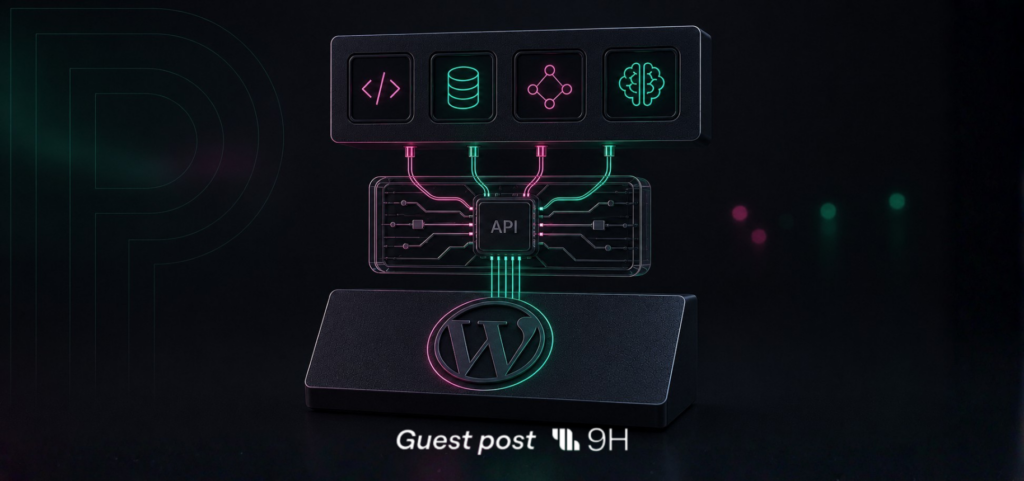
A hybrid stack does not mean abandoning WordPress. It means being deliberate about what WordPress does, and building purpose-fit systems around it for everything it should not have to do.
In practice, this often looks like three layers working together.
WordPress as the content and brand layer. The CMS does what it does best: managing content, powering the marketing site, running WooCommerce where relevant, and giving non-technical teams the editorial control they need.
A custom application layer for business logic. Complex workflows, data processing, multi-step automations, and internal tools belong in a properly engineered application. For us, that typically means Laravel: a mature, well-documented framework built for exactly this kind of work. We have used it to build everything from automated procurement platforms to demand intelligence dashboards sitting alongside a client’s WordPress front end.
An integration layer that ties it all together. The hybrid stack only works if the pieces communicate cleanly. That means proper API connectivity between WordPress and the custom application, and between those systems and the client’s existing tools: their CRM, ERP, payment infrastructure, and reporting stack. When done properly, the client experiences one seamless system. The seams are invisible.
When Clients Outgrow WordPress: The Warning Signs
It helps to know what to look for. In our experience, clients are ready for a hybrid conversation when:
They are managing critical business processes in WordPress that have nothing to do with content. If a team is using WooCommerce as a makeshift order management system, or ACF to store data that belongs in a relational database, WordPress is being asked to do something it was not built for.
Performance is suffering under the weight of integrations. Every third-party plugin that talks to an external service adds latency and risk. When a client’s site slows down because of payment processing or inventory sync, that is a system design problem, not a hosting problem.
The development team is spending most of their time on plugin conflicts rather than building new value. If more hours go into maintaining the WordPress ecosystem than into delivering something useful, the stack has become a liability.
They need real-time data that WordPress cannot surface. WordPress is not built for real-time. If a client needs live inventory, live pricing, or live reporting, a custom API layer will always outperform any WordPress solution.
The Breadth of Team Makes the Difference
One thing that has made this kind of work possible for us is having a team that genuinely spans both worlds. At 9H, we are a team of 100 across disciplines: WordPress developers, Laravel engineers, UX designers, AI specialists, integration architects, and brand strategists. The mix is intentional.
When a client brings a problem that crosses the line between website and business system, we do not have to hand them off or bring in an outside firm. The WordPress team and the custom application team work on the same project, against the same brief. That continuity matters more than it might seem, especially when the work involves connecting a marketing front end to a back-office system that has to stay perfectly in sync.
Our Malta base gives us a natural bridge between European enterprise requirements and global delivery. We work with clients across many industries, from financial services to hospitality to manufacturing, each with different regulatory contexts, different legacy systems, and different expectations of what a digital solution should deliver. That breadth keeps the team sharp.
AI and Automation: The Next Layer
If the hybrid stack has been the conversation of the last few years, AI and automation are the conversation of right now. Clients are asking for intelligent workflows: automated procurement that adapts to demand signals, AP automation that processes invoices without human intervention, reporting that does not just pull data but surfaces insights. These are not things you build in WordPress. But they do need to connect to the systems where a client’s brand lives, including, often, their WordPress site.
Teams best positioned to deliver on these requests are the ones who already made the architectural investment in hybrid stacks. If a proper application layer already exists, adding AI capabilities becomes a matter of extending what is there. If everything is still inside WordPress, you are starting from scratch every time.
A Practical Starting Point
Do not migrate for the sake of migrating. If WordPress is working well for the majority of a client’s needs, keep it there. Identify the specific pain points and build targeted solutions for those rather than re-platforming wholesale.
Invest in API design early. Clean APIs between components are what make hybrid stacks maintainable long term. Budget time for this upfront. It pays for itself in reduced integration headaches.
Be transparent with clients about what each layer is for. WordPress runs the content. The custom application runs the business logic. The integration layer connects them. That is a story clients can follow and trust.
Build for the team that will maintain it. A sophisticated architecture that only one developer understands is a future crisis. Build it so the broader team can work in it, debug it, and extend it.
The Bottom Line
The digital teams thriving right now are not the ones who work exclusively in WordPress. They are the ones who understand it deeply enough to know when a client needs something different, and who have the technical range to build it.
WordPress is not going anywhere. But the conversations around it have changed. The clients who have been with you long enough have grown into businesses that need more than a CMS. Building hybrid stacks is how you grow with them.

9H is a Malta-based digital company of 100 specialists spanning WordPress development, custom web applications, AI and automation, integrations, and brand building. With over 500 WordPress and WooCommerce builds across 15 years, and a growing practice in Laravel, API development, and enterprise AI, 9H works with businesses across Europe and beyond. Learn more at 9hdigital.com.