


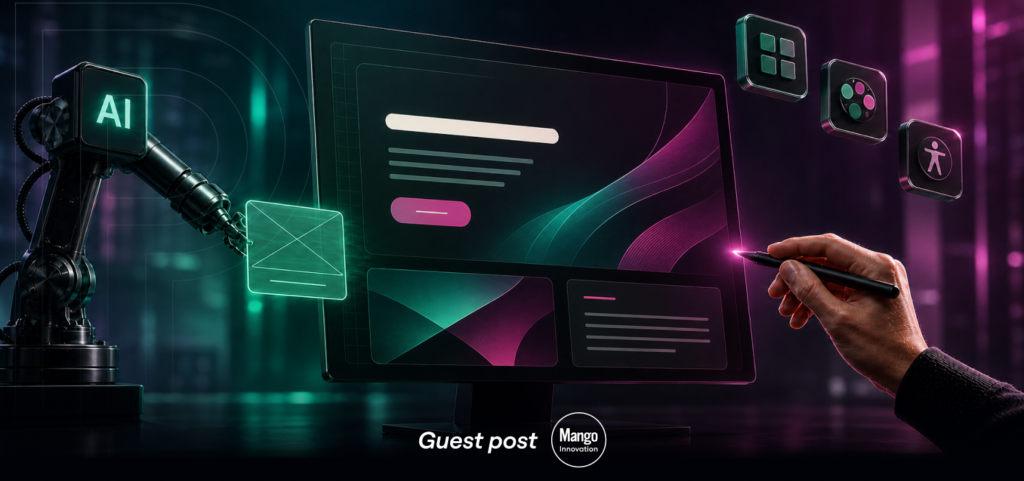
Open ten Product Hunt launches in a row this week. Same gradient hero. Same rounded card grid. Same badge with the little pulsing dot. Same font. You could swap the logos on half of them and nobody browsing quickly would notice.
That is not a coincidence and it is not a phase. It is the direct result of how the tools building these products actually work, and it is opening a door for WordPress that the platform has not had in years.
The AI builder wave changed how fast a product ships, not how good it looks
Lovable, Bolt, Cursor, and v0 have genuinely changed the economics of building software. A founder with an idea and no design background can have a working product live in a weekend. According to Figma’s 2026 study on web development trends, 68 percent of developers now use AI to generate code, and that number is only going up.
Here is the part nobody selling these tools wants to lead with: large language models do not create, they interpolate. They are trained on the entire internet, so their default output converges on whatever pattern shows up most often in that training data. A recent analysis of the phenomenon catalogued the tells, and they are recognizable on sight. Inter or JetBrains Mono as the typeface. Identical card components. The same hero, social proof strip, three-feature grid, pricing table, footer sequence, every time. Copy that leans on “supercharge your workflow” and “built for the modern team” because those phrases show up constantly in the training data too.
None of that makes the underlying product bad. It makes the presentation of the product invisible. As AI-generated sites, copy, and code get absorbed back into future training runs, the pattern compounds. The center of gravity tightens. The sameness deepens.
Generic design has a real cost, not just an aesthetic one
We put this into words on our own site earlier this year when we described the actual problem founders bring us: investors scroll past. Customers do not convert. A product that looks like a template gets treated like one, no matter how good the engineering underneath it is.
The accessibility gap makes the trust problem worse. A peer-reviewed evaluation of fifty AI-generated interfaces found persistent WCAG compliance failures across every tool tested, with text contrast as the single most severe recurring issue. Prompting the tools to “make it accessible” barely moved the needle. That tracks with the broader picture: the WebAIM Million 2026 report found that 95.9 percent of the top one million home pages on the internet still have at least one detectable WCAG 2 failure, the first increase in six years after a long run of small improvements.
Put those two data points together and the picture is plain. Speed shipped the product. It did not ship a voice, a visual identity, or a design that actually works for every visitor. That gap is not a footnote. It is the whole opportunity.
This is exactly the gap WordPress and its community are positioned to close
WordPress does not need to compete with Lovable or Bolt on speed, and trying to would be a losing argument. What WordPress has, and what an AI builder structurally cannot replicate, is a massive ecosystem of people whose entire job is story, structure, and craft: designers who ask why a product exists before they open Figma, developers who build a design system instead of accepting whatever a component library defaults to, and an accessibility-first mindset that treats WCAG AA as a floor, not an afterthought.
WordPress still runs 41.5 percent of every website on the internet and 59.2 percent of sites with a known content management system, according to W3Techs’ July 2026 numbers. That is not a platform in decline, it is the platform most likely to be where a product lands once it outgrows its MVP and needs to look like it belongs to somebody. The AI builder gets a founder to launch day. WordPress, and the people who build on it, are where that product goes to become a brand.
We built our own answer to this gap earlier this year and called it MangoSoul, human-led UX/UI design for teams shipping with Lovable, Bolt, Cursor, and other AI builders. The mechanics are simple on purpose. We start with a six-hour discovery conversation, no brief, no template, just us asking who the product is actually for and why it exists. From that conversation we build a story map and then design the full UX/UI in Figma: accessible by default at WCAG AA, responsive across mobile, tablet, and desktop, and visibly built for one brand instead of every brand. Then the client chooses what happens next. Hand the Figma file to Lovable, Bolt, or Cursor and let their AI builder reproduce it cleanly, or bring it to us and we build it in WordPress or Webflow. Either way, the design decisions were made by a person who sat with the founder, not by a model averaging the internet.
That is not the only way to run this playbook, and it should not be. It is one version of a much bigger opportunity sitting in front of every WordPress agency, freelance designer, and theme developer right now.
What this looks like if you want to build it into your own practice
The businesses winning this moment are treating AI as a power tool, not an autopilot, and that shows up in a few concrete habits:
Build the design system before you touch a prompt. Typography, color, spacing, and component behavior decided in advance and fed to any AI tool as constraints, not left for the model to default on its own.
Write down what your brand does not sound like. A one-page voice document that rules out “supercharge,” rhetorical-question paragraph endings, and the mic-drop one-liner pattern does more for differentiation than any prompt tweak.
Put a human in front of every AI output before it ships. One question does the work: could this have come from any of our competitors? If yes, it goes back for another pass.
Treat accessibility as a design requirement, not a plugin you bolt on later. Contrast, focus states, and semantic structure belong in the Figma file, because the data shows AI tools will not reliably get there on their own.
None of this requires abandoning AI builders. It requires putting a person with taste and judgment between the model and the client, which is precisely the role the WordPress community has spent two decades building around: designers, developers, and agencies who understand a business well enough to make it look like itself.
The opening will not stay open forever
Every founder using Lovable or Bolt today eventually hits the same wall: the product works, and it looks like everyone else’s. That moment is when they go looking for someone who can give it a story and a system, and right now most of them do not know that person or that agency exists yet.
WordPress and the people building on it have the community, the tooling, and two decades of design and development experience to be the obvious answer. The window to claim that positioning, before “human-led design for AI products” becomes its own crowded category, is open right now.

Derrick Boddie is Senior Web Developer and Executive Director at Mango Innovation, a Toronto-based web design and development studio, and the creator of MangoSoul, a human-led UX/UI design service for teams building with AI. He can be reached at derrick@mangoinnovation.com.